





News
|
Agenda
|
Guide of events
|
Processions
|
Pasos
|
Brotherhoods
|
History
|
Cieza
|
|
Music
|
Contact
News
|
Agenda
|
Guide of events
|
Processions
|
Pasos
|
Brotherhoods
|
History
|
Cieza
|
|
Music
|
Contact
Basílica de Nuestra Señora de la Asunción
Iglesia
Year: 1492

"Plaza Mayor", Number 7
History
The Basilica of Our Lady of the Assumption (declared a Site of Cultural Interest with the category of Monument) began construction in 1492. The original church, smaller than the current one, underwent its first restructuring in 1560, when the central nave was placed perpendicular to its original orientation. In the years following 1614, the main chapel, the vault, and the roof were completed. By the end of the 17th century, however, the church was in ruins due to successive expansions of the church and its chapels, which had affected the foundations, leading to its closure in 1694. Its reconstruction, begun a year later, was undertaken by the City Council. The new church, notable for its Rococo-Baroque facade, suffered a fire in the mid-19th century, necessitating renovations, including the construction of its bell tower. The works were completed in 1873.
Its three-aisled floor plan also includes five side aisles and the sacristy. In addition to the main entrance, it has two side doors: the Door of Saint Peter on the left facade and the Door of Saint Mary on the right. The original altarpiece of the main altar was sold at the beginning of the 19th century to finance the renovation of the Basilica's floor and replaced by another made in 1911 by Sebastián Guillén and Manuel Carrillo (who also carved the pulpit in wood), which was destroyed during the Spanish Civil War. The current altarpiece was made by carpenters from Cieza in 1940 and completed with six panels depicting Marian themes in 2004. A valuable organ of great artistic and musical significance was recently installed in the choir loft.
The chapels and niches house a number of processional images. Beginning a tour along the right aisle, one can see the Holy Christ of Mercy, the Holy Christ Lying in State and the Blessed Virgin of Sorrows, the Holy Christ of the Blood, Our Lady of Sorrows, Mary Most Holy of Solitude and an ancient image of the Lord of the Holy Sepulchre. To one side of the High Altar is the altarpiece-chapel of Our Father Jesus of Nazareth. A return tour along the left aisle allows one to contemplate the Blessed Virgin of Beautiful Love in the Blessed Sacrament Chapel, and subsequently Saint John, the Ecce Homo, the Blessed Virgin of Piety, the Lord of the Column and the Holy Christ of the Agony.
Outstanding news

 Popular news
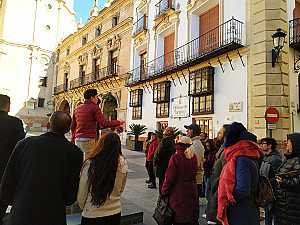
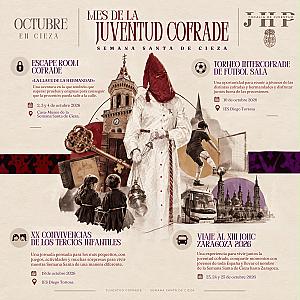
Cieza celebrates the 1st Youth Month with a wide range of activities
The 20th Children's Section Gathering will bring together Cieza's young Holy Week penitents next October 18
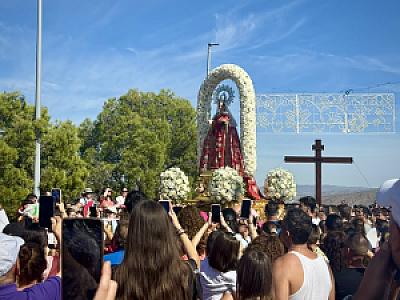
The "Santísima Virgen del Buen Suceso" now dwells in her Hermitage
ACTIVITY FOR HOLY WEEK 2020
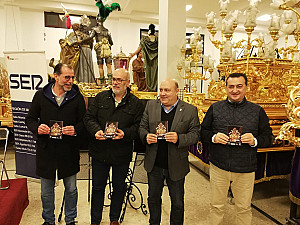
The Guide to Acts and Activities of Holy Week 2019 is presented at the Casa Museo de Cieza
The brotherhoods of Cieza visit the brotherhood houses of the Holy Week in Lorca.
Calendar