




News
|
Agenda
|
Guide of events
|
Processions
|
Pasos
|
Brotherhoods
|
History
|
Cieza
|
|
Music
|
Contact
News
|
Agenda
|
Guide of events
|
Processions
|
Pasos
|
Brotherhoods
|
History
|
Cieza
|
|
Music
|
Contact
Bringing of the Saints: Transfer of Saint John and Saint Mary Magdalene
Holy Wednesday afternoon
Holy Wednesday afternoon
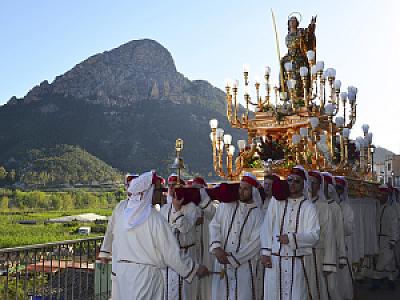
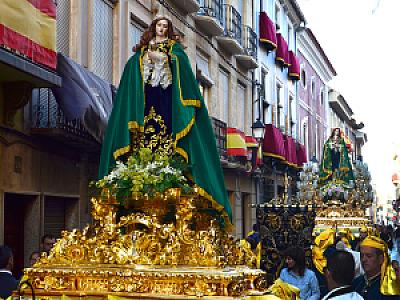
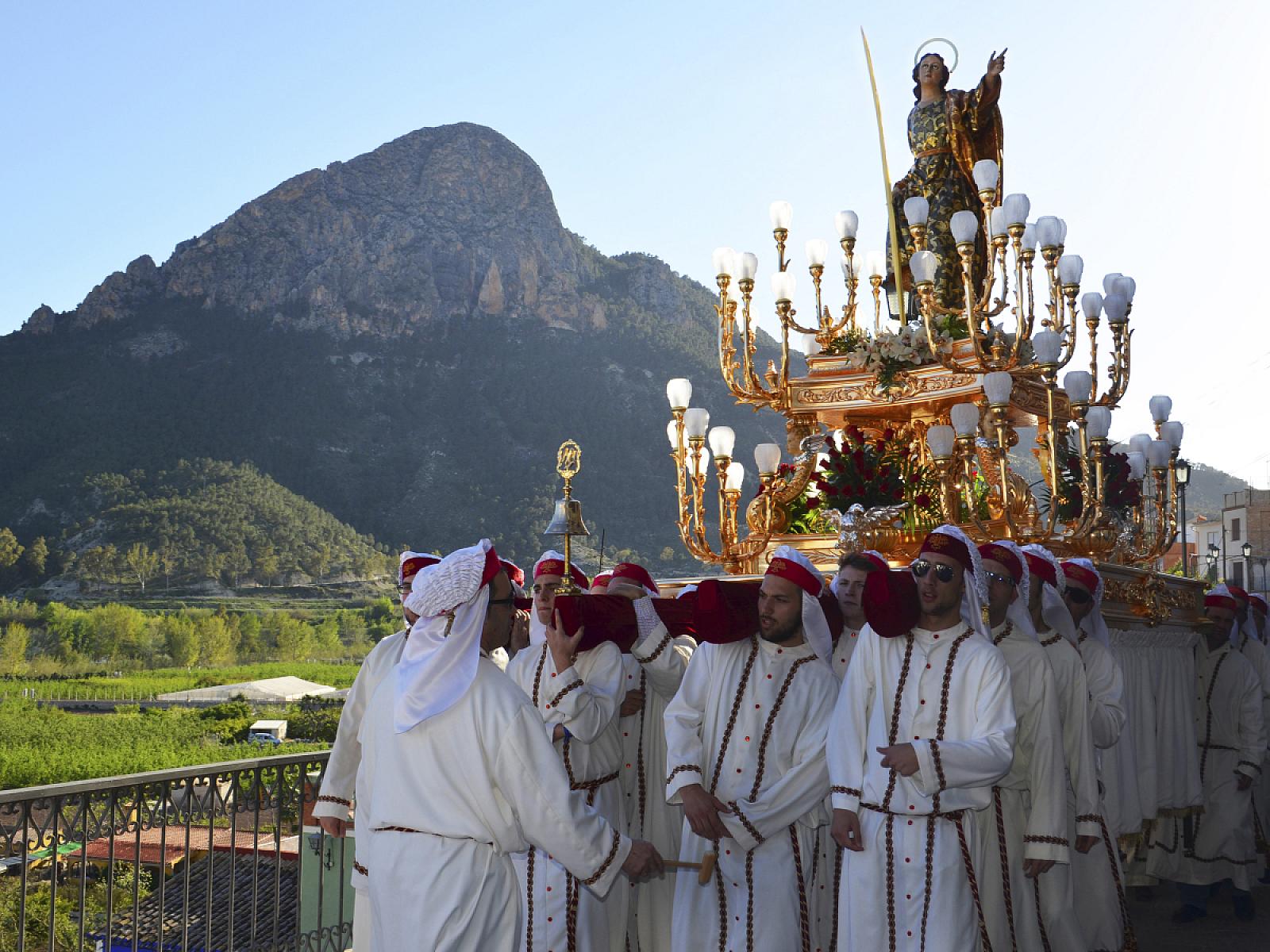
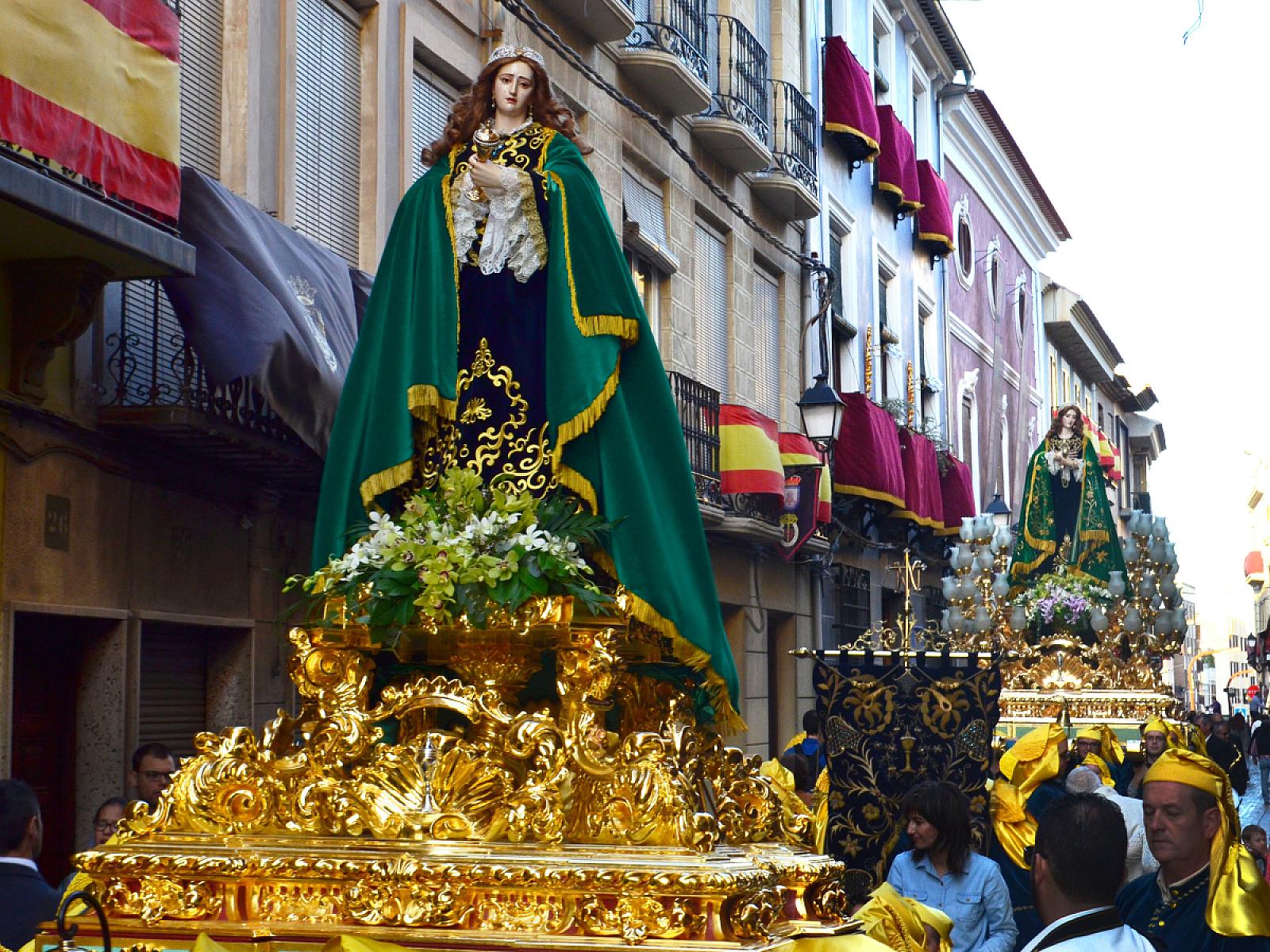
From the popular and deeply traditional Bringing of the Saints from the Hermitage of the Holy Christ of Consolation and other locations in the town, which typically consists of lively processions to carry the religious floats to the Basilica of Our Lady of the Assumption, these two transfers of Saint John and Saint Mary Magdalene remain. These floats are considered among the founding ones, so to speak, of those 'Bringings' that many generations of Cieza residents hold among their most cherished memories of Holy Week. Not so much out of necessity for the actual transfer to the 'House of the Saints'. but rather to ensure that this ancient, popular custom is not lost forever, these two brotherhoods continue to parade with their patron saints in the late afternoon to the sound of joyful pasodobles, preserving the unmistakable and endearing flavor of Holy Wednesday in Cieza.
Departure time for Saint John: 6:30 pm (Church of Saint John Bosco).
Departure time for Saint Mary Magdalene: 7:00 pm (House-Museum of the Brotherhood of Saint Mary Magdalene).
Route for Saint John: "Plaza de San Juan Bosco", "Avenida de Italia", "Plaza de las Cortes Españolas", "Paseo", Corner of the Convent, "San Sebastián", "Buitragos" and "Cánovas del Castillo".
Route for Saint Mary Magdalene: "Juego de Bolos", "Puerta de la Villa", "Mesones", Corner of the Convent, "San Sebastián", "Buitragos" and "Cánovas del Castillo". Order of procession of Saint John: children's group from the Brotherhood of Saint John the Evangelist, Children's float, Brotherhood of Saint John the Evangelist, Saint John and marching band.
Order of procession of Saint Mary Magdalene: children's third of the Brotherhood of Saint Mary Magdalene, children's float, Brotherhood of Saint Mary Magdalene, Saint Mary Magdalene and marching band.
Departure time for Saint Mary Magdalene: 7:00 pm (House-Museum of the Brotherhood of Saint Mary Magdalene).
Route for Saint John: "Plaza de San Juan Bosco", "Avenida de Italia", "Plaza de las Cortes Españolas", "Paseo", Corner of the Convent, "San Sebastián", "Buitragos" and "Cánovas del Castillo".
Route for Saint Mary Magdalene: "Juego de Bolos", "Puerta de la Villa", "Mesones", Corner of the Convent, "San Sebastián", "Buitragos" and "Cánovas del Castillo". Order of procession of Saint John: children's group from the Brotherhood of Saint John the Evangelist, Children's float, Brotherhood of Saint John the Evangelist, Saint John and marching band.
Order of procession of Saint Mary Magdalene: children's third of the Brotherhood of Saint Mary Magdalene, children's float, Brotherhood of Saint Mary Magdalene, Saint Mary Magdalene and marching band.
Unique features and suggestions: The processions are another of those typical and distinctly unique moments of Holy Week in Cieza; their impact on the people has been so profound that the nostalgia for those that are no longer performed is not even mitigated by the noticeable solemnity with which those more recently incorporated are carried out. In the case of Holy Wednesday, with a history parallel to that of the General Procession, the Bringing of the Saints has taken place since the last quarter of the 19th century: the floats that were to participate in the procession were moved, on the same day as the General Procession, from the place where they were kept throughout the year to the church. They left in two groups: from the Hermitage of the Holy Christ of Consolation came Saint John, Saint Peter, The Samaritan Woman and also, for a time, the Holy Christ of Consolation; at the Corner of the Town, Saint Mary Magdalene and The Agony in the Garden awaited them, and further along, The Flagellation joined the procession. With the construction of the House of Saints in the early seventies, the reason for the Bringing of the Saints disappeared, but, nevertheless, some brotherhoods, such as San Juan and Santa María Magdalena, have made that event a tradition that they renew on the afternoon of each Holy Wednesday.
In this context, it's essential to visit the statues of Saint John and Saint Mary Magdalene, who are the heart and soul of this afternoon, imbued with the traditional flavor of Holy Week. Without any prior planning, one must follow the route in reverse until they are seen approaching in the distance, splendid in their usual procession atop their beautiful processional floats. It is also particularly moving to watch from a distance as each float is preceded by its child counterpart, carried by the children of both brotherhoods, eager to demonstrate that they are now true Ciezan bearers.
Photographs by Juan Fernández.
© Board of Passionate Brotherhoods of Cieza
© Board of Passionate Brotherhoods of Cieza
Gallery
Outstanding news

 Popular news
Rules of the XXXIX Poster Competition 'Holy Week in Cieza'
Pablo Espinosa will be in charge of creating the poster for "The Arrest" 2027
Official statement: Postponement of the 20th Children's Section Gathering
ACTIVITY FOR HOLY WEEK 2020
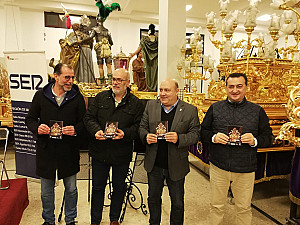
The Guide to Acts and Activities of Holy Week 2019 is presented at the Casa Museo de Cieza
The brotherhoods of Cieza visit the brotherhood houses of the Holy Week in Lorca.
Upcoming events
24 October - 10:00
XIII National Gathering of Youth from Brotherhoods and Confraternities
24 October - 20:00
Holy Mass
25 October - 07:00
Rosary of Dawn
25 October - 10:00
XIII National Gathering of Youth from Brotherhoods and Confraternities
30 October - 19:00
Triduum
30 October - 19:00
Food collection
Calendar