




Holy Saturday early morning
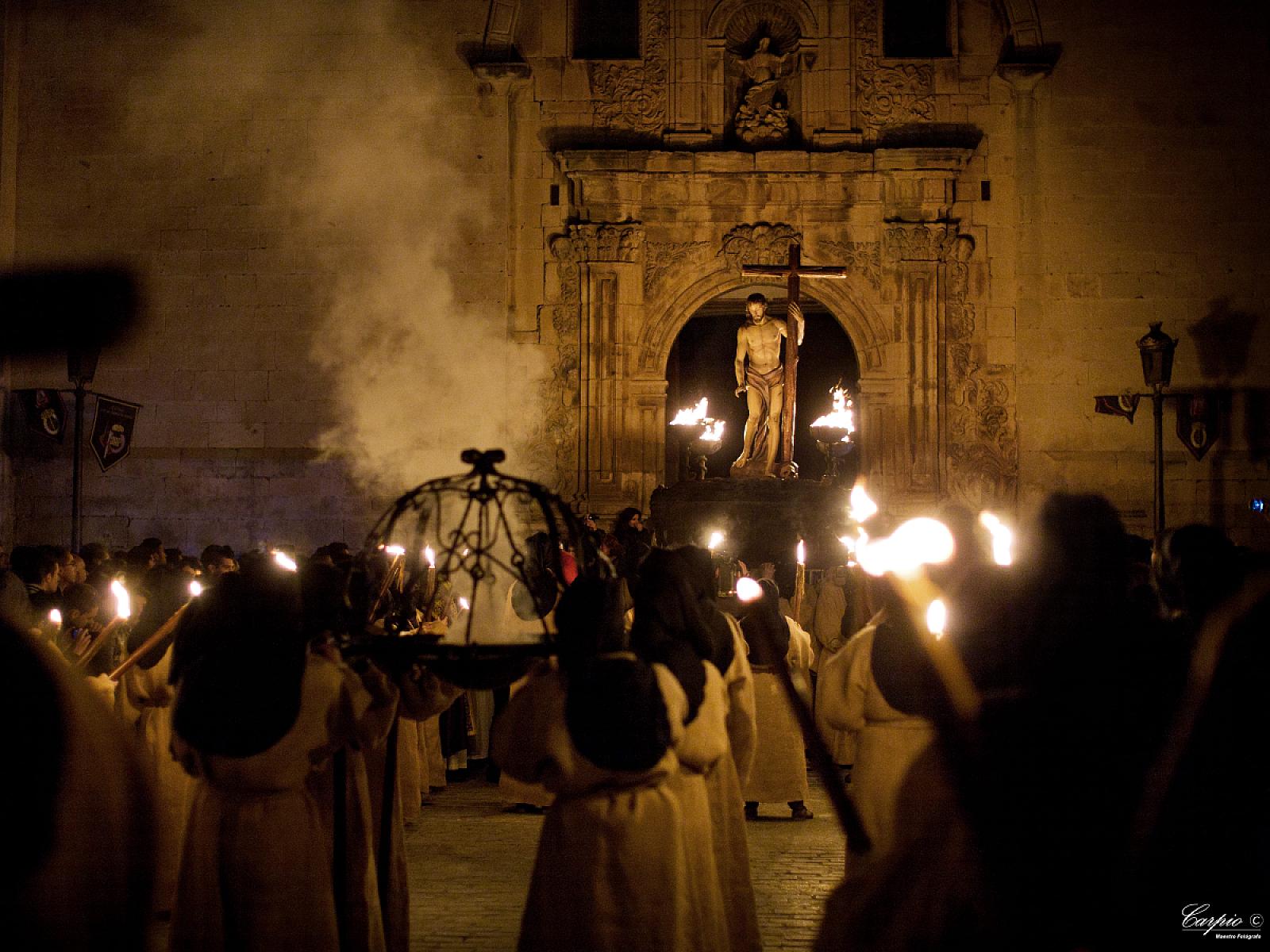
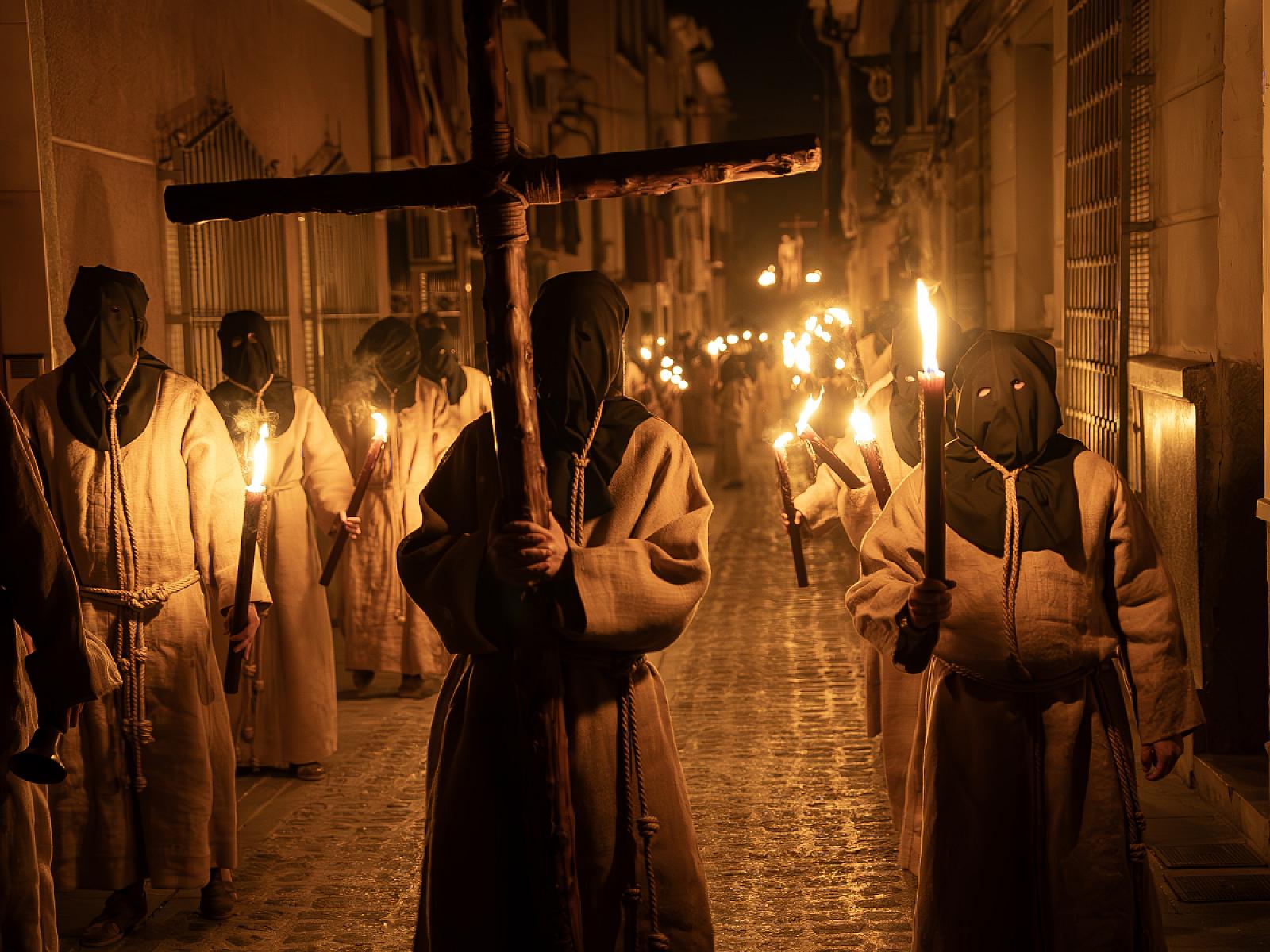
This unique procession begins with the oath of silence taken by the members of the brotherhood at the Hermitage of Saint Bartholomew. From there, the group of penitents, in their distinctive sackcloth robes and carrying torches, makes their way to the Basilica of Our Lady of the Assumption, whose doors, in response to the call made by the brotherhood with its processional cross, open to reveal the passage of Jesus opening the gates of hell.
After the reading of the Holy Saturday homily at the foot of the church steps, the procession sets off, announced by the ringing of the bell at its head. As was the case during the Procession of Silence, the streetlights and the interiors of the houses along the route will also remain off for this procession.
In that atmosphere, typical of the Middle Ages, the procession, by the light of the fire of its four braziers and to the sound marked by a single muffled drum, whose monotonous cadence is only interrupted by a chamber group or the voices of a choir that performs sacred chants such as Signore delle Cime in certain locations, travels its unique route to return at very late hours of the morning, close to the dawn of Holy Saturday.
Departure time: 3:00 am (the penitents leave the Hermitage of Saint Bartholomew and proceed along "Cid" Street to the "Plaza Mayor", upon arrival, the float departs from the Basilica of Our Lady of the Assumption).
Arrival time: approximately 5:30 am (Basilica of Our Lady of the Assumption).
Route: "Plaza Mayor", "La Hoz", Descent to the Iron Bridge, Ascent to the Iron Bridge, "Rincón de los Pinos", "Pinos", "Larga", "Buitragos", "Empedrá", "Barco", "La Hoz" and "Plaza Mayor".
Order of Procession: Banner of the Board of PassionATE Brotherhoods, Confraternity of Souls, Jesus opening the gates of hell and clergy.
Unique features and suggestions: After a few minutes of respite, barely allowing time to recover from the emotions evoked by the entrance of the Holy Burial Procession, the spectator prepares to experience another unforgettable moment. In the darkness of the early hours of Holy Saturday, the Procession of Christ's Descent into Hell will take place; this procession is a landmark in Spanish Holy Week processions, being the first of its kind in the entire country. The importance of this contribution from Cieza to the context of Spanish Holy Week processions is evidenced by the replica of this procession that has been held in Archena since 2007 (also sponsored by the corresponding Brotherhood of Souls in Archena, which arose following the model of the Cieza brotherhood).
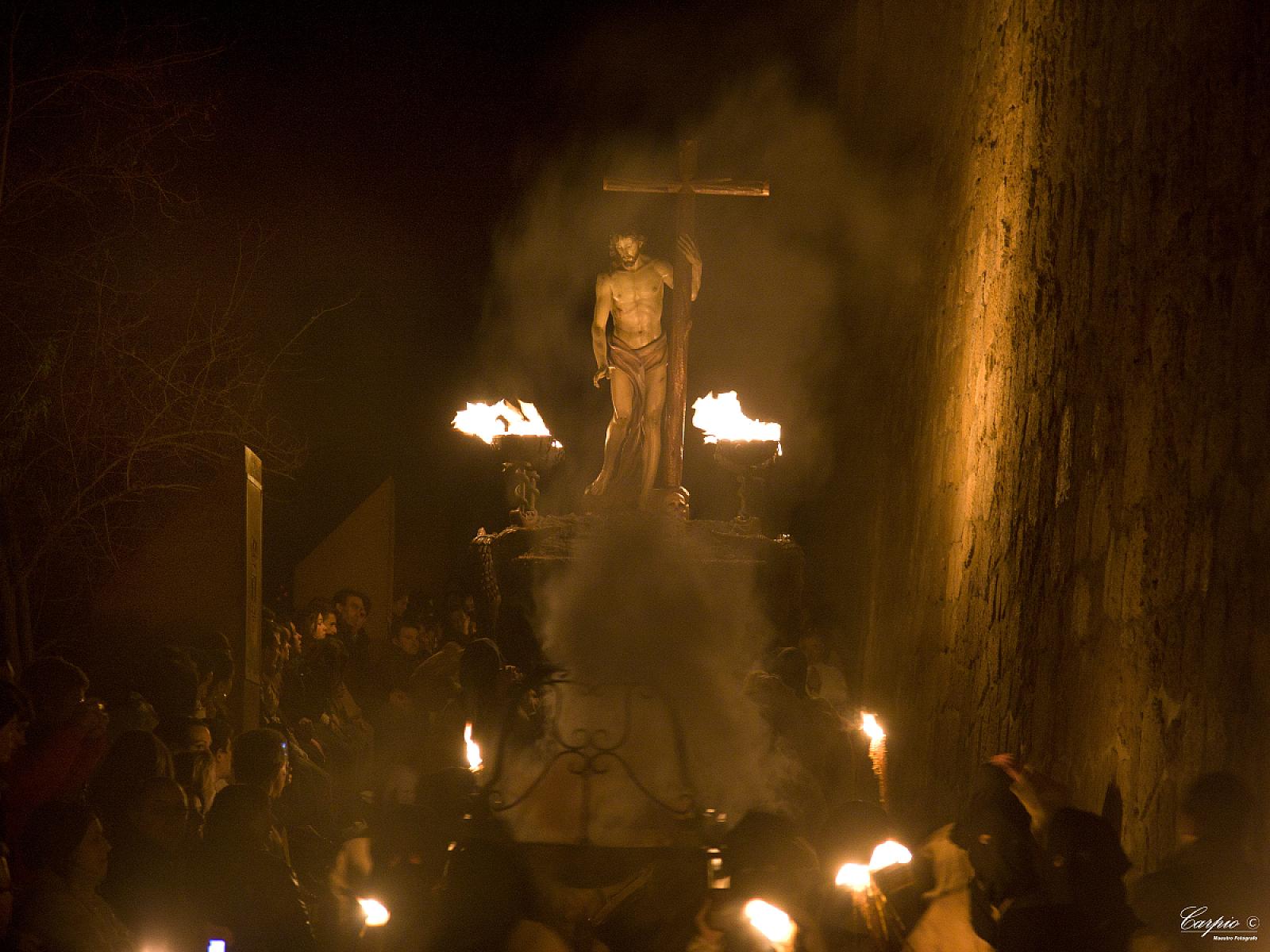
For any visitor, it's essential to be in the square when, in the darkness, the Third of Nazarenes arrives, led by a processional cross, and heads towards the basilica's portico. The three knocks of the cross on the basilica door cause it to open, revealing the impressive sculpture of Jesus opening the gates of hell (Hernández Navarro) on a throne carved with chisels depicting various scenes from the holy scriptures (Soriano Talavera). Once in the square, and after listening, in profound silence, to the brief Holy Saturday Homily, the procession begins. Those wishing to follow these recommendations should then proceed along Cartas Street towards the Muro (where the 19th century wall meets the 15th century fortress) to experience the procession's most distinctive moment, as the cortege descends towards the Segura River. Then, as Christ extends his redeeming hand and descends the wall (one might say truly descending into Hell), the play of shadows created by the light of the Nazarenes' torches and the fire emanating from the censers of the throne upon the stones of the Wall, combined with the austerity and sobriety of the burlap robes, the silence of the procession -broken only by the occasional performance of choral music- the ringing of the bell of souls that opens the cortege next to the cross, and the incessant and penetrating smell of incense, recreates in an astonishing and impactful way a penitential atmosphere is recreated that allows the spectator to travel back in time and forge a memory that will cling to the memory forever.
Thus concludes, in this early morning, the unique and unrepeatable story of Good Friday, in which, in just over twenty-four hours, Cieza falls silent and then reenacts the Gospel passages that go from the condemnation of Christ to his Descent into Hell, passing through his Passion, Death and Burial with the participation of the entire town, devoted without reservation to its great day.
Photographs by Manuel Carpio and Enrique Centeno.
© Board of Passionate Brotherhoods of Cieza